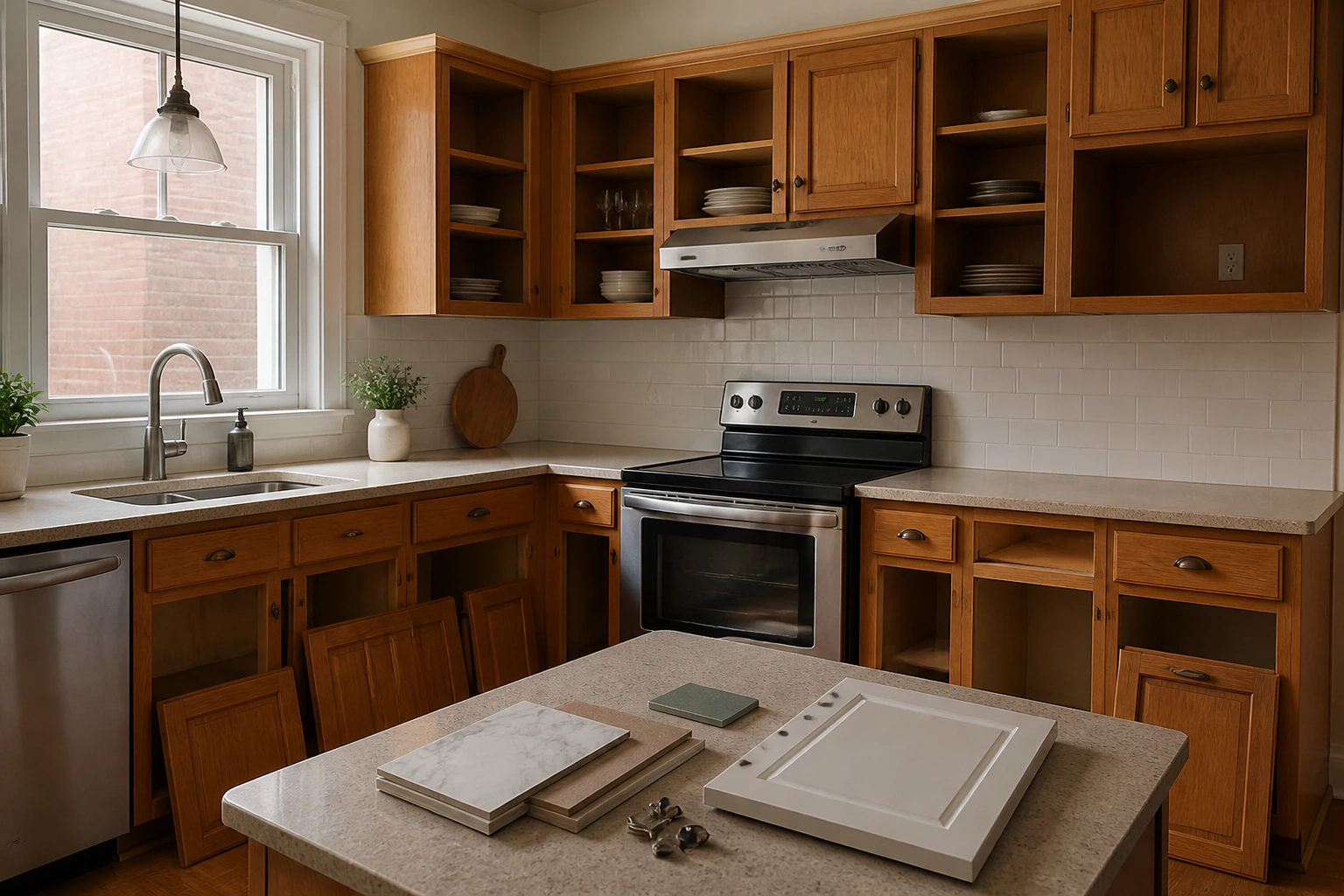
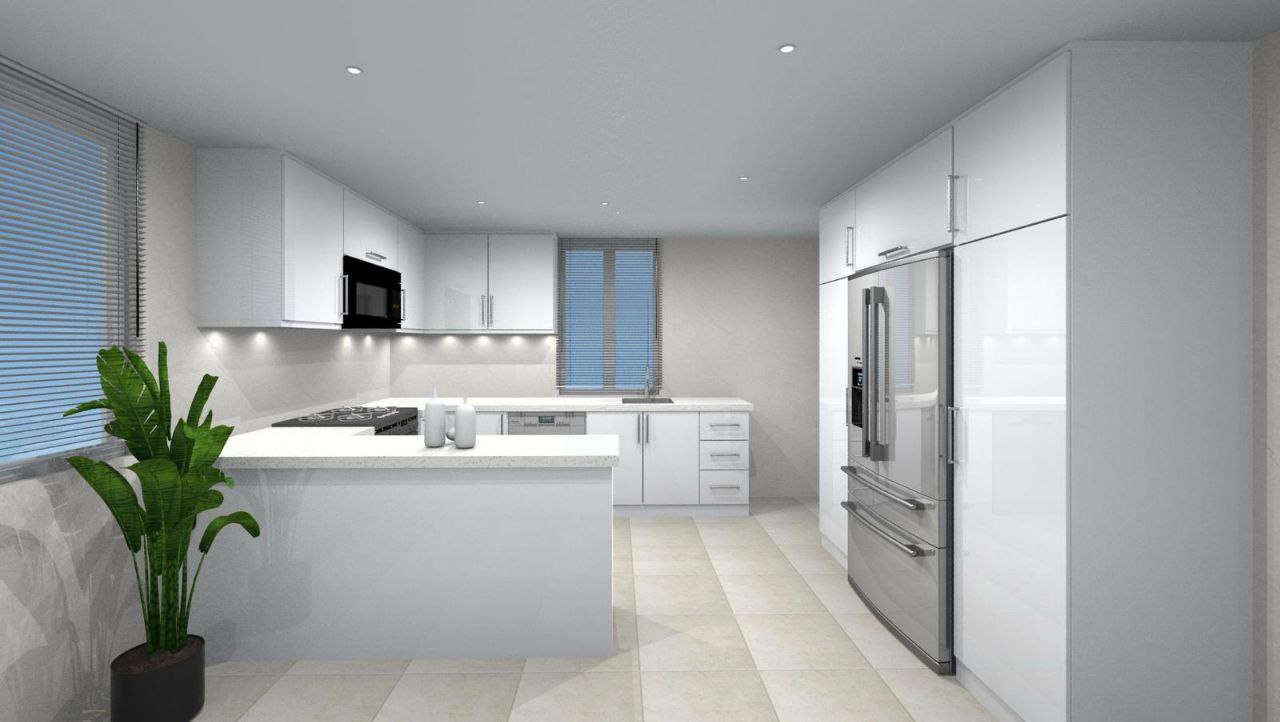
How Do You Restore Wood Kitchen Cabinets?
October 2026 - 8 min read
Dull or worn wood cabinets can often be restored. Here is how to assess the cabinet box and surface, choose between upkeep, refinishing and renovation, and avoid the mistakes that make a finish peel.
First, identify what you really have
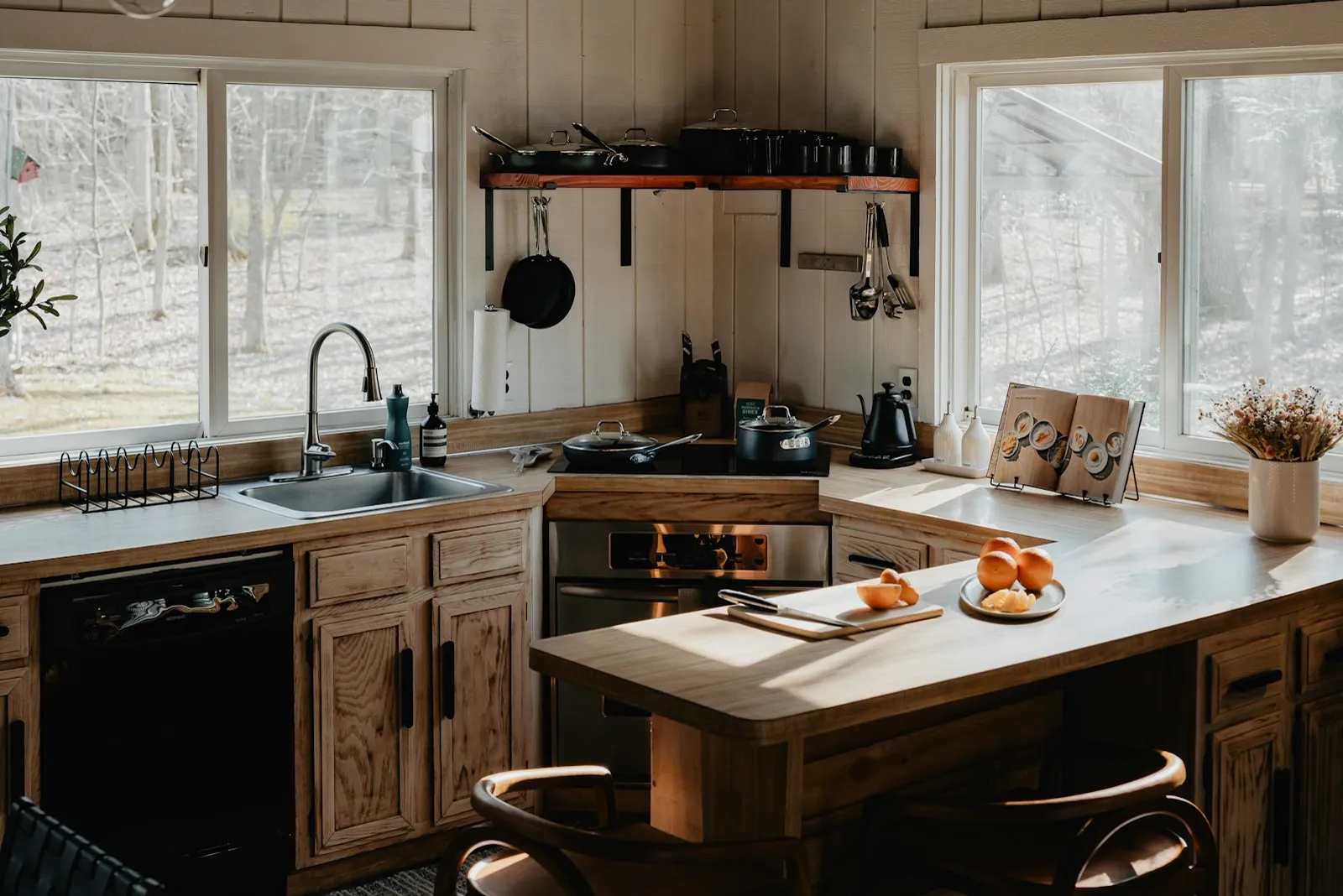
"Wood cabinets" covers very different materials, and they are not restored the same way. Take off a door and look at the edge, the back and the inside of the box.
- Solid wood: can be sanded, repaired, stained or painted; the most restorable
- Wood veneer on panel: restorable, but the wood layer is thin and can barely be sanded
- Painted MDF: repaints well, but does not tolerate water once the edge is open
- Thermofoil (moulded vinyl film): cannot really be restored once it peels; the front usually needs replacing
Assess the cabinet box before the surface
A beautiful finish on a damaged box will not last. Check inside every base cabinet, especially under the sink and beside the dishwasher. If you find any of the problems below, the question is no longer refinishing but the condition of the kitchen.
Keep, reface or replace: the full diagnosis- Swollen panels, a sagging bottom or repeated water marks
- Persistent odour or mold
- Boxes that move, are poorly fastened to the wall or out of square
- Drawers whose structure, not just the slide, is broken
Level 1: dull but sound surface, clean and revive
In a kitchen, most "dull" cabinets are mainly coated in grease. A thorough degreasing followed by a care product suited to the existing finish often restores the shine. Small scratches can be hidden with a touch-up marker or wax in the right shade. New handles and adjusted hinges complete the refresh without touching the finish.
Level 2: worn finish, refinish
When the varnish is worn through to the wood around the handles, or you no longer like the colour, the finish has to be redone. The result depends almost entirely on preparation, the step that quick jobs skip.
- Empty the cabinets, remove doors, drawers and hardware, and number every piece
- Degrease thoroughly: leftover grease is the first cause of peeling
- Repair holes, chips and joints before sanding
- Sand for adhesion, or strip if the old finish is thick or flaking
- Choose the right primer: on oak, a stain-blocking primer stops tannins from yellowing light paint
- Apply a paint or varnish made for cabinets, in thin coats
- Respect the manufacturer's cure time before heavy use
Level 3: localized damage, repair or replace some parts
A split door, a lifted edge, a sagging shelf or worn slides do not justify replacing everything. These parts can often be repaired or swapped individually. If several doors are damaged or you no longer like the style, another route is to keep the boxes, paint them and replace the doors.
What ConsQualif offers for existing cabinets
When the boxes are sound and standard-sized, we paint the cabinets and replace the doors. You keep the structure and layout, and the kitchen gets a new look without demolition. If the boxes are damaged or non-standard, we tell you during the visit and compare with a replacement.
Level 4: when restoration is no longer enough
If the boxes are water-damaged, the layout does not work or you lack storage, refinishing does not fix the real problem. A kitchen renovation then lets you address the structure, plumbing, electrical and countertop at once, rather than paying twice.
See our kitchen renovation processSafety, and situations for a professional
Older cabinets may carry lead-based paint, especially in homes built before the 1980s. Have it tested before sanding or stripping, and never dry-sand suspect paint in an occupied room. A professional is also recommended when boxes need refastening, when the finish should be sprayed for an even result, or when the restoration is part of plumbing or electrical work.
Restore the cabinets before changing the countertop
If you are also planning a new countertop, decide on the cabinets first. The countertop is fabricated to the exact position of the boxes; restoring or replacing them afterwards can compromise the new surface.
How to replace a kitchen countertopBefore restoring your cabinets
- - Identify the material: solid wood, veneer, MDF or thermofoil
- - Inspect the boxes under the sink and beside the dishwasher
- - Classify the condition: clean, refinish, repair or replace
- - Have existing paint tested if the home is older
- - Plan full preparation: degreasing, repairs, sanding, primer
- - Decide on the cabinets before ordering a new countertop
Sound wood cabinets are often worth keeping: properly prepared, a refinish transforms the kitchen without demolition. If your boxes are standard-sized, ConsQualif can paint them and replace the doors. If water, structure or layout is the problem, a renovation is safer than a finish that will not hold. During a free visit, we look at your kitchen and give you a detailed written estimate.
FREE ESTIMATE
Ready to start your project?
Get a free, no-obligation estimate. Our RBQ-licensed team replies quickly.